Compare Repair to Replacement
Repair usually costs less upfront. Compare a written repair estimate with the full replacement cost, including delivery, installation, financing, and haul-away charges.
Phoenix Appliance Repair Co. explains that repair is usually cheaper upfront, but washer age, the failed part, repair history, and the price of a comparable new machine determine the better long-term choice. In Phoenix, hard water and garage heat can also accelerate wear on fill valves, pumps, belts, hoses, and seals, so a diagnosis matters before you decide.
Repair usually costs less upfront. Compare a written repair estimate with the full replacement cost, including delivery, installation, financing, and haul-away charges.
Washers last 10 to 13 years on average. A machine under 5 years old is usually worth repairing, while a major failure near or beyond the average lifespan points toward replacement.
Replacement becomes more sensible when parts are discontinued, a washer past 8 years needs a drum, transmission, or control board, or the machine has already needed two repairs in the past two years.
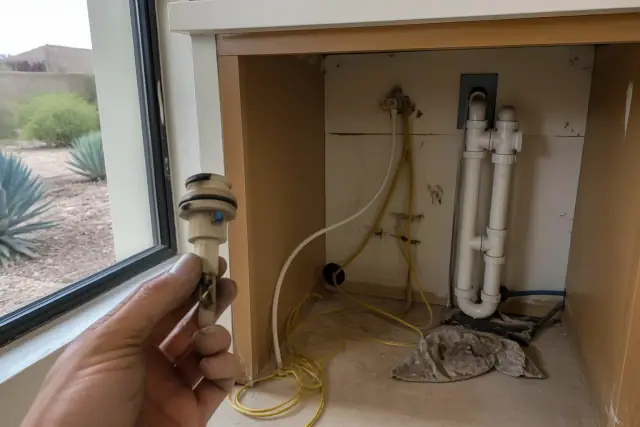
Mineral scale around water connections and any water left in the tub. These clues help distinguish a routine valve or pump repair from a broader washer problem.
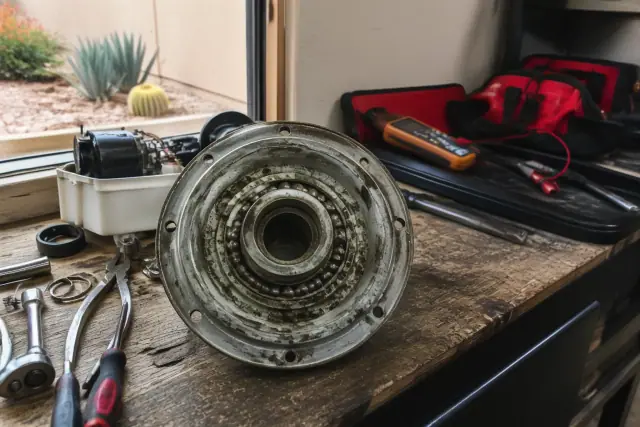
Capture door-seal damage, leaks, mold buildup, and the area around a vibrating drum. Seal and bearing symptoms can move a front-load repair into a higher cost range.
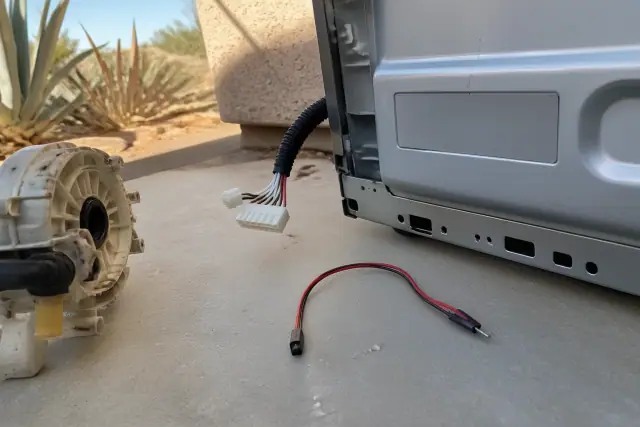
Photograph the model tag, displayed error code, and control panel before requesting an estimate. The information helps identify parts availability and whether the symptom points to electronics or a mechanical component.
A washer under 7 years old with only one previous repair is generally worth fixing again, provided the current estimate remains reasonable for the machine's condition.
If the repair estimate exceeds half the cost of a comparable new washer, replacement usually makes more financial sense. Below that threshold, age and repair history still matter.
A second major component failure within 18 months suggests recurring costs are becoming part of the decision. Replacement can be the better long-term option even when the new repair is technically possible.
Include delivery, installation, haul-away, financing, and expected water and energy use over the next 5 to 10 years. Those costs can make an affordable repair more competitive than the washer prices alone suggest.
| Common Repair | Typical Cost Range | Clue to Check |
|---|---|---|
| Lid switch | $80 to $150 | The cycle will not start because the switch is not engaging. |
| Belt or pulley | $100 to $200 | The drum is not turning or the belt is slipping. |
| Agitator | $100 to $250 | Wash performance is poor or the cycle does not complete. |
| Timer | $100 to $225 | The washer advances through the cycle incorrectly. |
| Drain pump | $125 to $250 | Water remains in the tub after the cycle. |
| Fill valve | $125 to $225 | The washer fills slowly, fails to fill, or overflows. |
| Motor | $150 to $400 | The washer will not start or only hums. |
| Seal or tub seal | $150 to $300 | Water leaks from the base or odors develop. |
| Drum or bearing | $200 to $450 | Grinding, heavy vibration, or drum damage is present. |
| Control board | $200 to $450 | Error codes repeat or controls stop responding. |
Straightforward washer repairs have a median out-of-pocket cost around $155, while complex motor, control board, or drum work often runs $300 to $450. Front-load major repairs range from $200 to $500, top-load service averages $125 to $350, and high-efficiency electronic repairs often run $250 to $450. By comparison, basic top-load washers start around $600 to $750, mid-range and high-efficiency front-load machines run $900 to $1,500, and premium large-capacity units can exceed $1,900; even a $380 repair may still beat the complete replacement cost.
The failed part, washer type, age, repair history, and remaining parts availability all change the recommendation. A motor or control-board failure on a 9-year-old washer is often a tipping point, while belts, hoses, and switches may still justify repair between 8 and 10 years; past 10 years, a practical cutoff is a repair under $100. Phoenix hard water can build scale in fill valves and pumps, while extreme garage heat degrades rubber belts, door seals, and hoses faster, so local operating conditions belong in the diagnosis.
How much should you expect to spend? Most jobs fall between $125 and $450, with an average around $180 to $220; a simple lid-switch repair may stay under $150, while a motor or control board can reach $450. Can you try a repair yourself? Checking a clogged drain hose may be manageable, but motor, board, drum-bearing, and main-seal work involves electrical, water, and further-damage risks. What should you ask before deciding? Request a written estimate, confirm the failed part and included work, and compare that total with a like-for-like replacement.
Share the washer's age, symptoms, error code, repair history, and any signs of leaking, grinding, poor draining, or fill problems. A written washer repair estimate gives you the number needed to compare repair with replacement before authorizing work.